

Before you begin
- For Call sub-agent: an agent with two sub-agents, each with a provider. See Create an agent.
- For Agent Task Tool: a second agent that is enabled and whose entry is a trigger. See Entries and entry handlers.
- Both checks run the agents. Your model company bills you for those runs.
Let a sub-agent ask another sub-agent
The example is an agent named Support desk. ItsSupport sub-agent answers customers, and asks a Researcher sub-agent for the facts first.
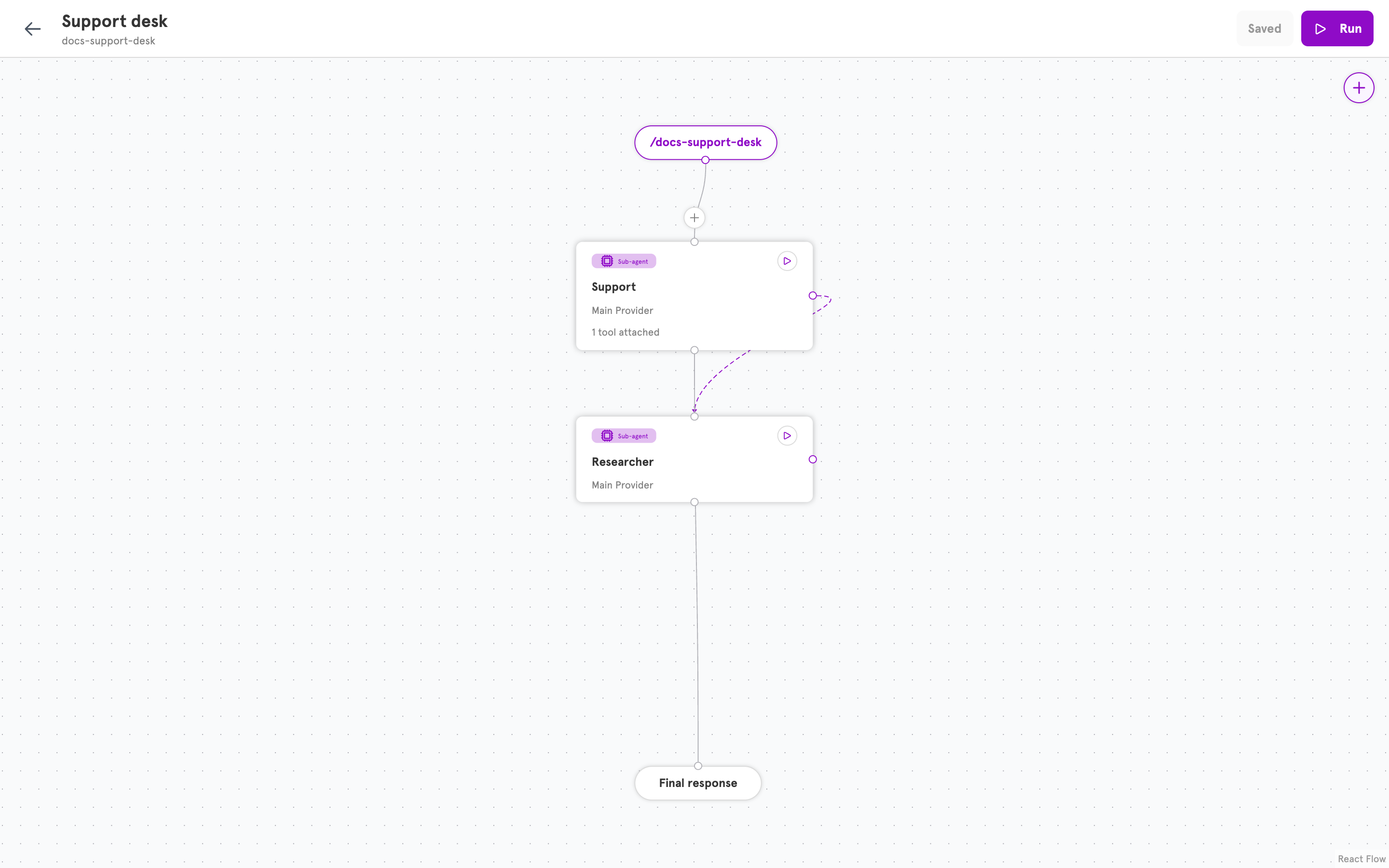
1
Open the calling sub-agent
Click
Support on the canvas. Its panel opens.2
Add the tool
Under Tools, open Add a tool… and choose Call sub-agent…. The Configure Call sub-agent dialog opens.
3
Name the tool
In Display name, enter
ask_researcher. Use letters, numbers, and underscores, with no spaces. Some model companies reject a tool whose name contains a space.4
Say when to use it
In When to use, enter
Ask the researcher to look up the facts needed to answer the customer. The model reads this to decide when to call the tool.5
Choose the sub-agent to call
Under Sub-agent, choose 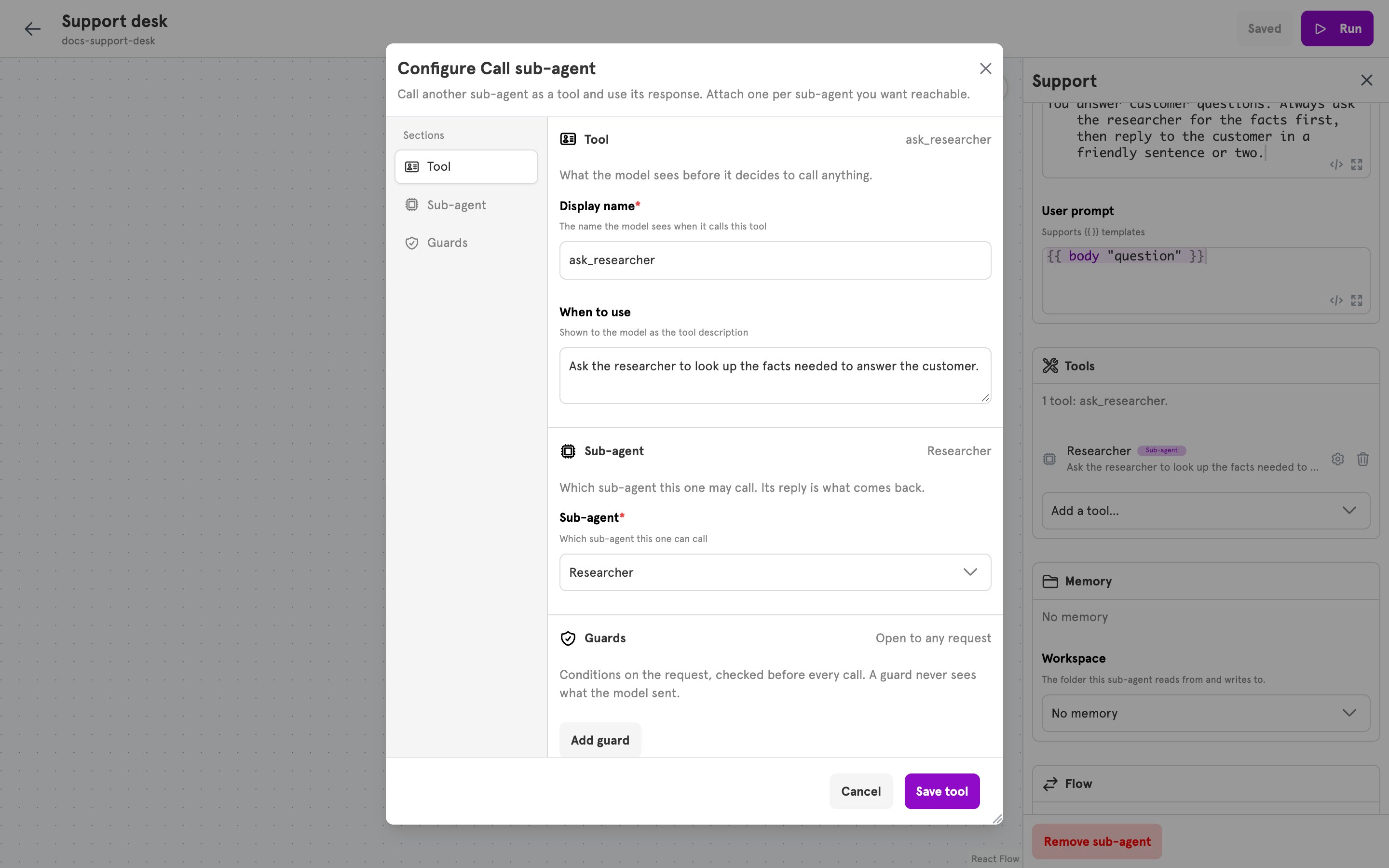
Researcher.6
Save the tool
Click Save tool. The tool appears under Tools.
7
Tell the calling sub-agent to use it
In the System prompt of Without this, the model may answer on its own and never call the tool.
Support, say when to use the tool:8
Set what the called sub-agent asks
Click Give it a System prompt for its own job, such as 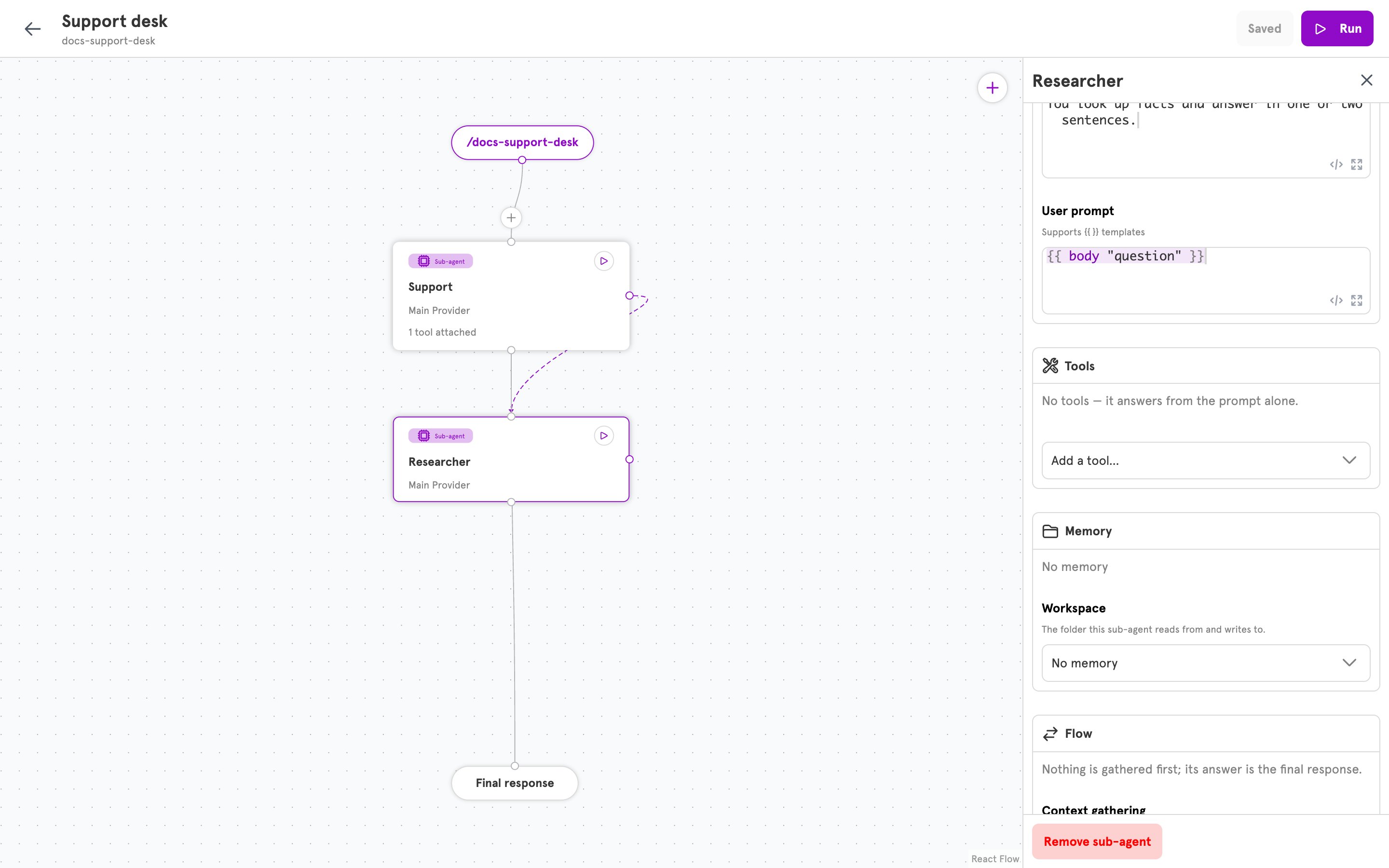
Researcher. The caller does not pass its question along. The called sub-agent asks whatever its own User prompt says, so point that prompt at the message that started the run:You look up facts and answer in one or two sentences.9
Save and run
Click Save, then Run, and enter a request:The Log shows 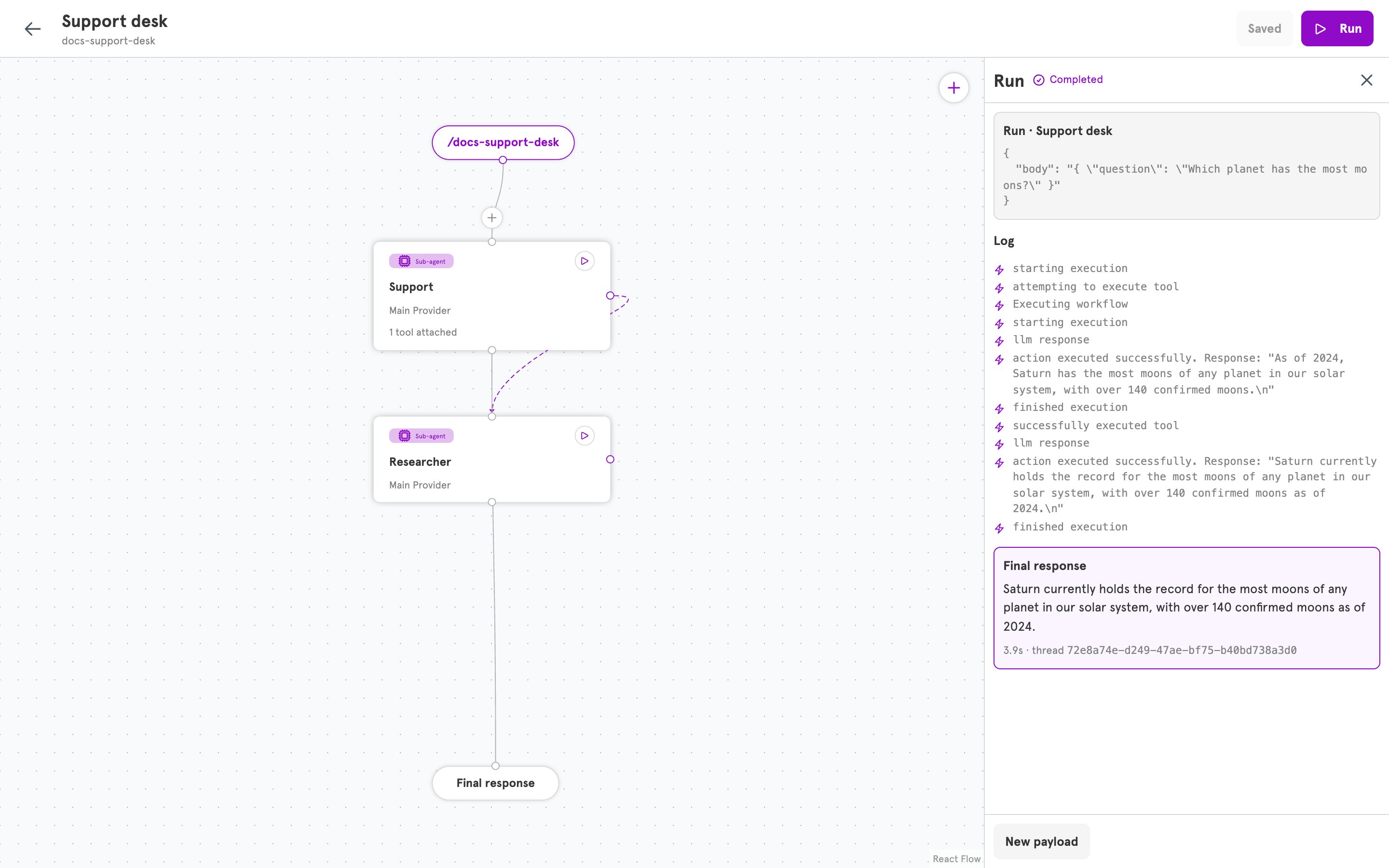
Support starting a tool, Researcher answering, the tool finishing, and then the reply from Support.Pass a question of the caller’s own
If you create agents from config files, the calling model can write its own question for the called sub-agent. Declare a parameter on the tool withparams, and read it in the called sub-agent’s prompt with tool_param:
userPrompt then reads {{ tool_param "question" }}. The dashboard’s Configure Call sub-agent dialog has no setting for parameters. For the whole shape of an agent, see the CLI reference.
Hand a task to another agent
The example is a Helpdesk agent that hands report writing to a separate agent named Weekly report.1
Check the other agent
Open the Weekly report agent. Its entry has to be a trigger, and the agent has to be enabled.
2
Make the other agent read the task
In its sub-agent’s User prompt, enter:Click Save. The task arrives under the name
instruction.3
Add the tool to the first agent
Open the Helpdesk agent and click its sub-agent. Under Tools, open Add a tool… and choose Agent Task Tool…. The Configure Agent Task Tool dialog opens.
4
Name the tool and say when to use it
In Display name, enter
start_weekly_report. In When to use, enter Hand over writing the weekly report. Say what it should cover.5
Choose the agent
Under Agent, choose Weekly report. The list shows enabled agents whose entry is a trigger.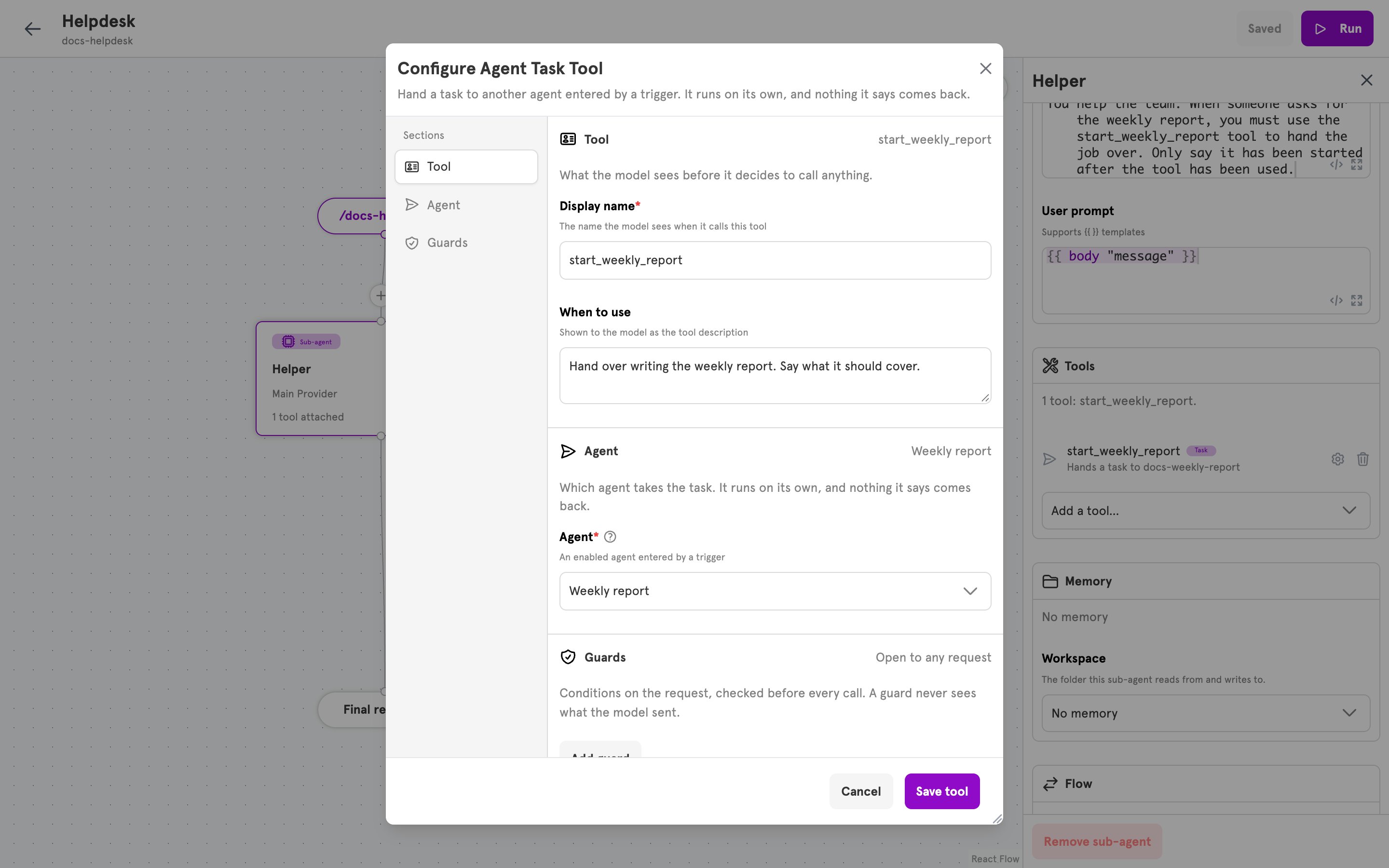
6
Save the tool and tell the agent to use it
Click Save tool. In the sub-agent’s System prompt, say when to use the tool and what to say afterwards:Without the second sentence, the model may say the report has started without starting it.
7
Save and run
Click Save, then Run, and ask for the report. The Log shows “attempting to execute tool” and “successfully executed tool”, and the agent replies that the report has been started.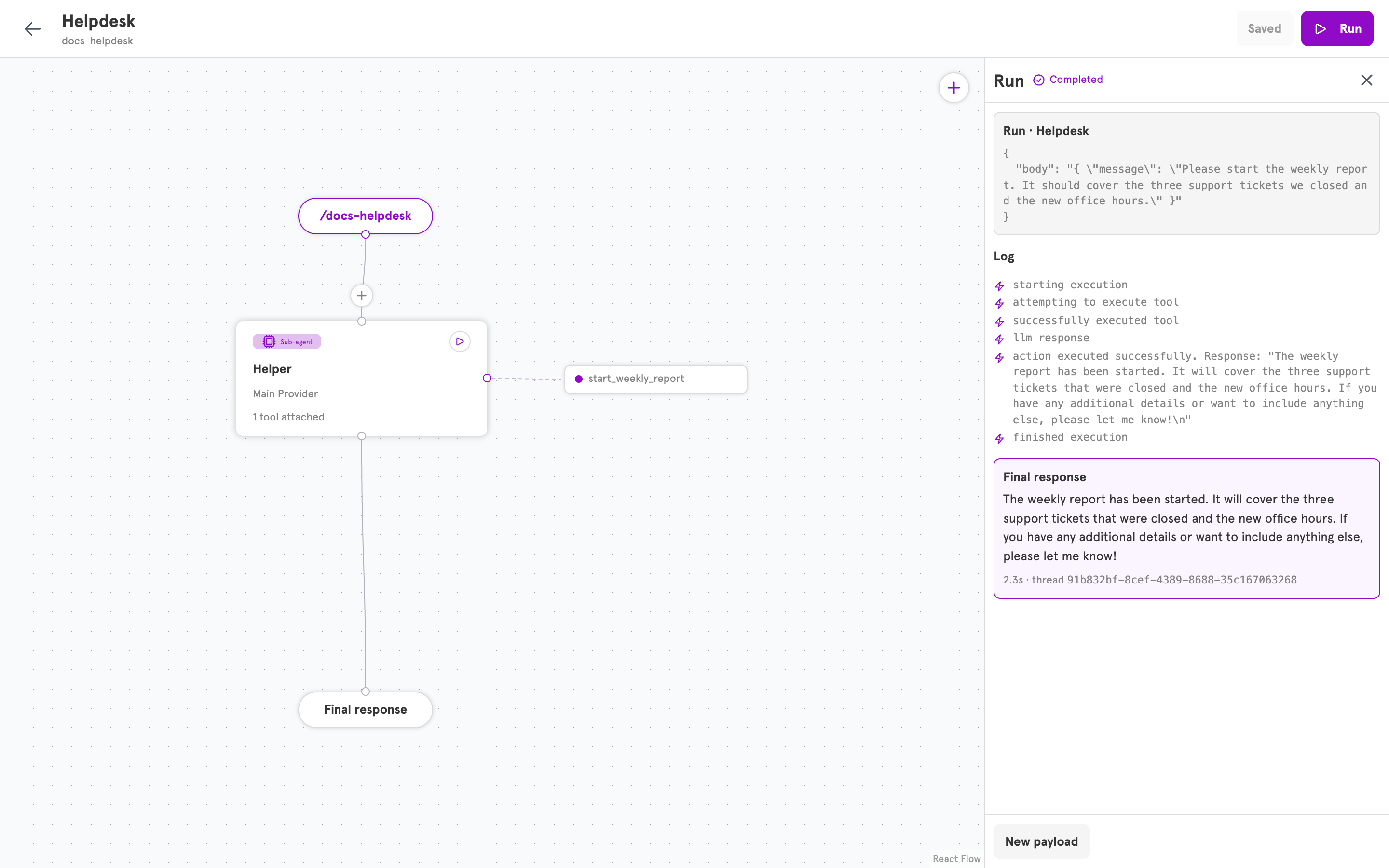
Limit who can set this off
Both tools take guards. A guard checks who sent the message before the tool runs, so you can let everyone talk to an agent while only some people can make it call another one. See Guard rails.Related
Add a tool to an agent
The other kinds of tool a sub-agent can have.
Guard rails
Limit what people can make your agent do.
Entries and entry handlers
Triggers and the other ways an agent is started.
Tools
Every tool type and its fields.